First month free with promo codeFirst month free with codeEveryone else starts with 30 free calls and 30 minutes.Redeem DEEPGRAMStart free

The Phone Is the Next Agent Primitive. Somebody Has to Build Your Side of It.

On this page
  1. The oldest interface is still the default one
  2. The builders are doing exceptional work
  3. Who the automation is for
  4. What exists for you so far
  5. Why a personal phone agent is a different product
  6. When both ends are bots
  7. What we’d like you to take from this
  8. Frequently asked
  9. Sources

Every agent capability so far has been a way of reaching some part of the world. The browser reached the part that lives on websites. Computer use reached the part that lives inside software. Email is reaching the part that lives in inboxes. The phone is the part that’s left, and it is larger than it looks from inside a tech company. We founded ClawCall to build that capability for one specific party: you. The rest of this is why that distinction matters.

The oldest interface is still the default one

Most of the physical world never put its state online. More than half of US small businesses still book appointments by phone, and a quarter of the people who call a business do it because what they needed wasn’t on the website. The full picture is in Hiya’s State of the Call 2026 and the Zoho Bookings small-business survey.

So an assistant that can book your flight and draft your emails still can’t find out whether the tire shop has your size in stock. It hands the errand back to you. The thing that makes a capability a primitive, rather than a feature, is that every agent needs it and no agent can get by without it. Browser use crossed that line in 2024. Calling is crossing it now.

The builders are doing exceptional work

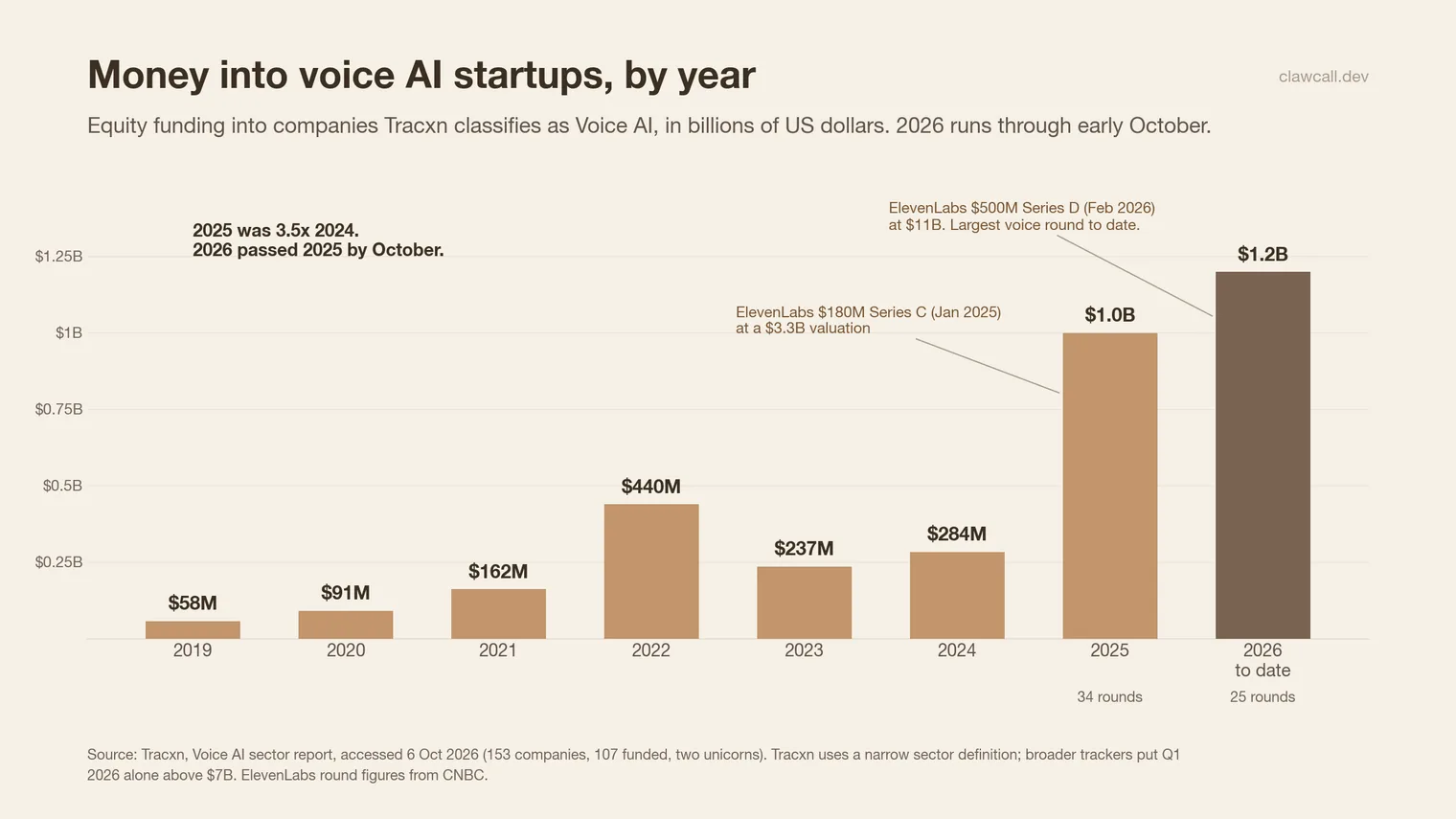
Bar chart of equity funding into voice AI startups by year, 2019 to 2026 to date, from Tracxn: under $500 million a year through 2024, $1 billion in 2025, $1.2 billion in 2026 by early October
Voice AI funding by year. 2025 was three and a half times 2024, and 2026 passed 2025 before October. Source: Tracxn.

We’re for voice agents. All of them. The teams building them have solved problems that looked intractable two years ago, and the market has noticed. By Tracxn’s count, 2025 was a record year for voice AI funding at three and a half times 2024, and 2026 passed that record before October. Broader definitions put the first quarter of this year alone above $7 billion. ElevenLabs, the sector’s biggest name, raised $500 million at an $11 billion valuation in February. The primitive is here.

One observation, though. Nearly every one of those calls has an AI on the business side and a human on the other. There’s a plain reason for that. The buyer with a budget line is the business, so the business is who gets built for. A one-truck plumber can’t staff a phone, and a receptionist for $29.99 a month is a good deal for him. If we ran a two-chair barbershop we’d buy one tomorrow.

Who the automation is for

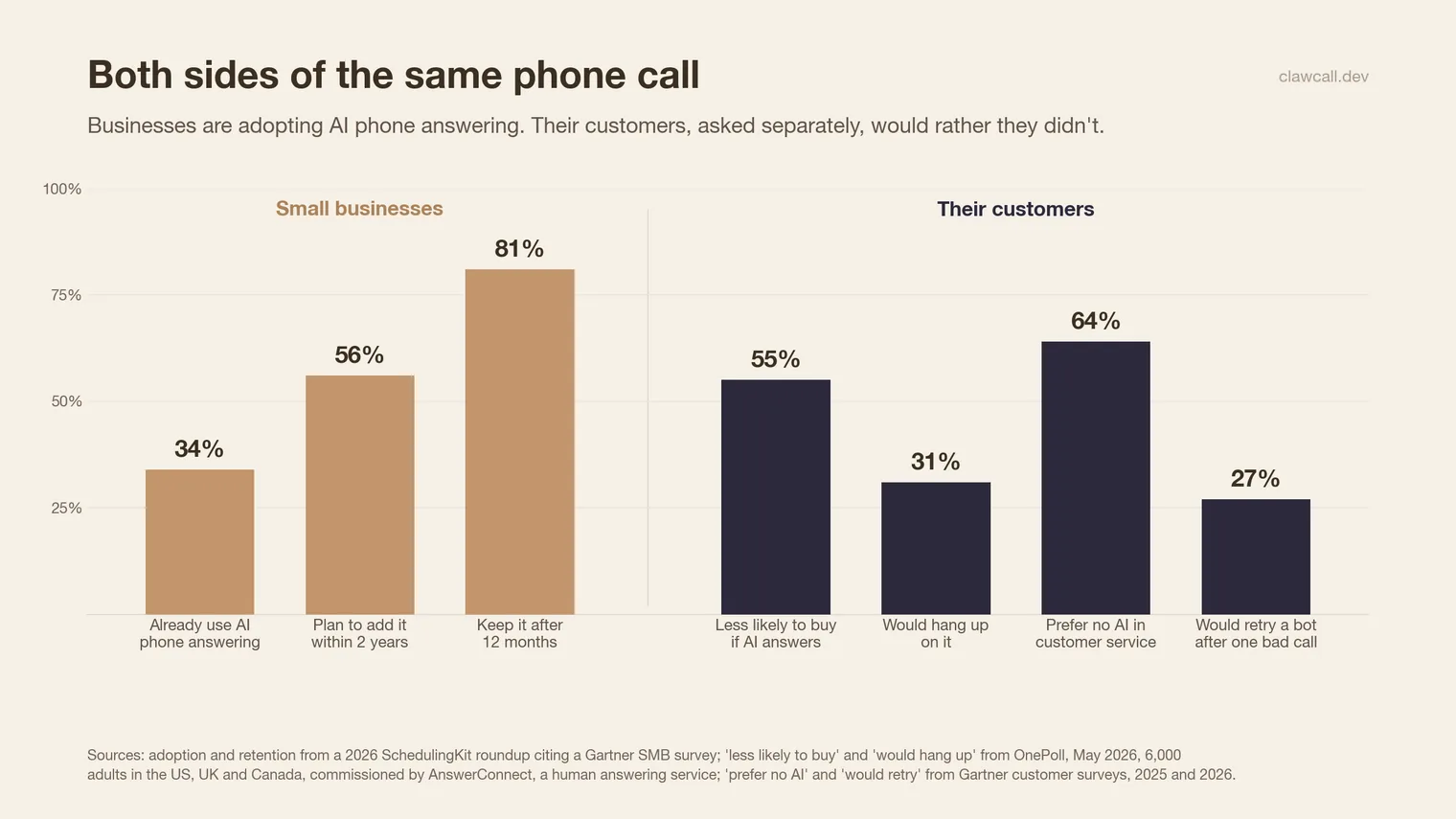
Bar chart comparing small-business adoption of AI phone answering (34% use it, 56% plan to, 81% keep it) with customer sentiment (55% less likely to buy, 31% would hang up, 64% prefer no AI, 27% would retry after a bad call)
Businesses are adopting AI phone answering. Their customers, asked separately, would rather they didn’t.

A third of US small businesses already answer the phone with AI, and most of the rest plan to. Their customers, asked separately, say they’d rather it didn’t. Both of those are true at once, and the market grows anyway, because the person who pays for the bot and the person who sits through it are different people. (Adoption data; customer survey, commissioned by a human answering service, so read it with that in mind.)

One survey puts the average American at 41 minutes on hold a month, and none of that time appears in any vendor’s dashboard. The business pays for the bot’s minute. Nobody pays for yours.

Every automation serves whoever paid for it. That’s a neutral fact about tools, and it’s true of the receptionist too. It answers, it books, it takes a message, and it does all of this in the interest of the business that installed it. Your interest on that call, which used to be represented by a person who could be reasoned with, now has nobody representing it at all. Until recently that was only true at insurers and airlines. Zoom now sells the same thing to anyone with a dial tone, so it’s about to be true at the bakery.

Good for the bakery. Harder for you, unless something on your end can talk to it. That second half is the problem we picked.

What exists for you so far

Google has gotten furthest. Its new Call for Me lets Gemini place a call from your own number, sit through the menu and talk to whoever picks up. It’s a small test, on one phone model, behind one subscription. Apple’s Hold Assist waits on hold for you but won’t dial or speak.

We’re glad both exist. They are also tied to one phone and one assistant, with one company deciding what you’re allowed to ask for. A primitive has to work from whichever agent you happen to be using.

Why a personal phone agent is a different product

Taking calls for a company and making calls for a person share a speech layer and almost nothing else. A few things we had to build that a receptionist never needs.

It works in both directions under one identity. Most of what people hand us is outbound. But the clinic calls back, and the contractor returns the voicemail, and with 86% of unknown-number calls going unanswered a lot of those callbacks die there. So on ClawCall your assistant can answer a number that’s yours, on the Reserve Plus plan, as well as dial out from it.

It can hand the call to you. A business bot routes to a department. A personal agent hits moments only you can handle: “can you confirm the card on file,” “the doctor would like a word,” “we could do Tuesday at 3.” When that happens, if you’ve turned loop-in on, the agent rings you, tells you who’s on the line before connecting anyone, and lets you decide whether to join. It also will not read out or relay card numbers, government IDs or one-time codes, even if you ask. Those steps stay yours. An agent that speaks for a person needs a line it won’t cross on their behalf, and we’ve been surprised how few draw one.

It belongs to whichever agent you’re using. Nobody runs one assistant anymore. The same account, the same number and the same history should be reachable from ChatGPT, from an OpenAI dot, from a Grok bot, from Claude, or from a script on your laptop at 2am. So we shipped it as a connector those hosts sign into (OAuth, no API key in a chat window) and as a skill for coding agents, instead of as another app you’d have to open. Browser use spread the same way. Every assistant got it; you never switched to a browser-use app.

And when someone on the call asks whether they’re talking to a person, ours says no. Every time. A receptionist bot dodges that question because the business is embarrassed about it. Your agent has nothing to be embarrassed about. It’s calling for you, it says so, and in our experience it still gets the appointment.
When both ends are bots

The question we get most is whether this ends with your bot calling their bot and nobody talking. Probably, for routine calls, and we think that’s fine. If two agents settle a Tuesday slot in fifteen seconds while you’re in a meeting, you got what you wanted. The version we’re worried about is the one we’re drifting into now, where their side is automated and yours isn’t.

Once both ends are automated, the call is decided by whose agent knows more. The business bot knows its menu and its calendar. Yours knows your calendar, your insurance ID, your tolerance for a 7am appointment, and what you said you’d pay. That’s a real advantage, if your agent actually has a phone.

What we’re building next is on that side of the call: an agent that works out, before it dials, what’s worth asking and what you’d accept, and sometimes tells you a call is the wrong move and a web form would do. We call it an advisor mode internally and it’s early.

What we’d like you to take from this

Build the voice agents. All of them, for every business that needs one. We mean that. The only thing we’d add is that if every business is about to have an AI on the phone, you need one too, and yours has to work for you and only you.

ClawCall is free for your first 30 calls, no card, and plugs into the assistant you already use. US numbers only for now, in English, which we’d rather say up front than have you find out. What’s the call you’ve been putting off for a month? That’s the one to try it on.

Frequently asked

Is ClawCall against AI receptionists?

No. Businesses that can’t staff a phone are right to use one, and ClawCall itself answers one reserved number on its Reserve Plus plan. The essay’s point is that the customer’s side of the call needs an agent too, and that is the side ClawCall builds for.

Which AI assistants can place calls through ClawCall?

ChatGPT and OpenAI dots through the official plugin, and Claude, Grok Bot, Cursor and other hosts that support remote MCP with OAuth through the hosted connector at https://api.clawcall.dev/mcp. Coding agents without remote MCP can use the packaged skill or the REST API. The for-agents overview lists each host’s path.

What does ClawCall keep from a call?

The call details, the network outcome, and transcript evidence when the call captured any. ClawCall deletes transcripts 7 days after a call ends and recordings 10 minutes after a call ends, so ask your assistant to summarize anything you want to keep.

Does ClawCall say it is an AI on calls?

Yes, whenever someone on the call asks, and you cannot turn that off. The AI honesty post explains why.

Sources

This essay was written by the founders at ClawCall. Figures were checked on against:

Keep reading

Hand off the next call.

Free trial: 30 calls and 30 minutes, whichever lasts later. No credit card.

Text ClawCall